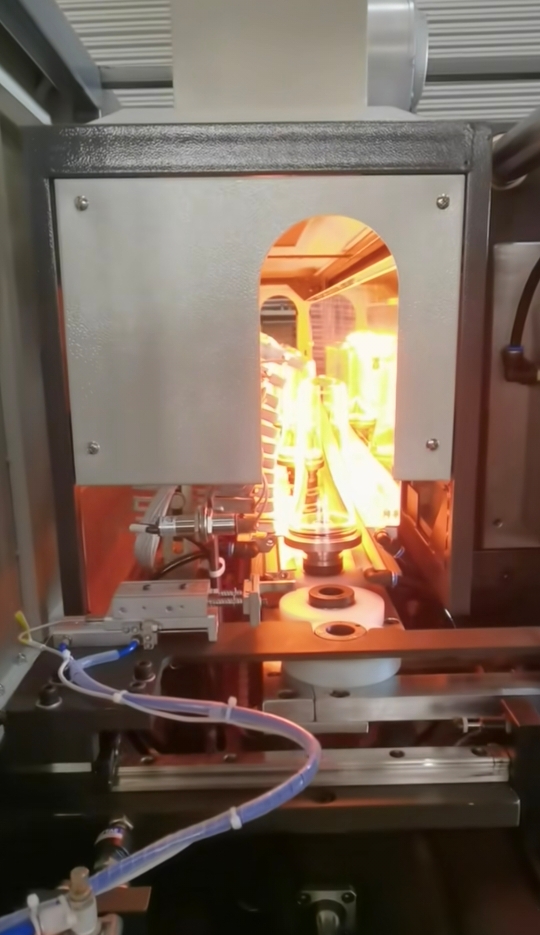
On the floor, you don’t have time to chase uneven preform heating or babysit a tunnel that drifts out of tolerance. When the infrared emitter starts underperforming, the blow molder compensates the wrong way—temperature swings show up as haze, stretch marks, and blown bottles. What you need is heat that repeats, cycle after cycle, and a lamp that swaps in without re-engineering the oven. The Ruby infrared lamp is built as a direct-fit, spec-matched replacement for short-wave infrared heating in PET stretch blow molding. It’s engineered to meet the thermal and mechanical expectations of major platforms—Sidel, Krones, SIPA, Husky, SACMI, and Nissei ASB—so you can replace without redesigning the heating section.
What matters, technically
This is a short-wave infrared emitter, tuned for fast response and tight control—exactly what PET preform heating demands. In practice, the preform surface hits target quickly, with minimal overshoot, so the heating window stays stable even when line speed changes. Here are the points you can spec and verify:
- **Spectrum:**Short-wave infrared, optimized for rapid, surface-driven heating of PET preforms.
- **Construction:**Quartz tube with a ruby-tinted coating that shapes spectral output and holds up under repeated thermal cycling.
- **Wattage and voltage:**Available in standard blow-molder ratings—commonly 1,000 W to 1,500 W, with 120 V and 240 V options—so you match the machine’s electrical configuration without rewiring the zone.
- **Connector type:**Fits OEM-standard connectors across blow molders—R7s base and compatible terminal blocks—so installation is a straight swap.
- **Physical fit:**Length and end-fitting geometry match common heating tunnel assemblies, preserving alignment and clearance.
- **Thermal behavior:**Fast start-up and fast cool-down reduce idle-state heat loss and help keep zone temperatures repeatable during changeovers. None of this is arbitrary. PET preform heating needs high power density and quick response to keep the polymer in range without overheating. Short-wave infrared delivers that, and the mechanical dimensions make sure the heat lands where the machine was designed to receive it.
Why it works in the real process
In blow molding, the heating tunnel is the first constraint. If the lamp can’t hold setpoint, the blow station pays—more rejects, more scrap, and more micro-adjustments on the machine. With the Ruby lamp installed, you get:
- **Stable preform temperature, shift after shift.**Tighter control in the tunnel translates into more consistent biaxial stretching. Fewer quality excursions from cold spots or overheated necks.
- **More uptime, fewer stoppages.**The lamp is built for the realities of a running line—thermal cycling, vibration, and repeated start/stop events. When it holds output without sudden drops, you spend less time troubleshooting heater faults.
- **Energy use that behaves predictably.**Short-wave infrared concentrates energy where it’s needed—on the preform surface—reducing wasted heat in the tunnel structure. That can move the energy curve in the right direction, especially on lines that run long hours.
- **A replacement that fits your maintenance plan.**Because the lamp matches the original equipment’s electrical and mechanical footprint, you can keep spares on the shelf, swap on schedule, and avoid overtime calls to rework the heating section. This matters when schedules are tight and margins are thin. A stable heating zone lets the blow molder run at its designed pace, and the quality team sees fewer spikes in wall-thickness variation and clarity issues.
What you need to know before you swap one in
The Ruby lamp is designed as a direct-fit replacement, but field conditions still matter.
- **Confirm the zone configuration.**Even with the same wattage, some machines use different lamp lengths or mounting arrangements. Measure the existing lamp, verify the connector type, and cross-check the heating-zone layout before ordering.
- **Match voltage and wiring.**The wrong voltage will underperform or fail quickly. Check the terminal block rating and supply wiring; if your line has variable voltage, specify the lamp accordingly.
- **The control matters as much as the emitter.**If the temperature controller is aging, you can still see drift with a new lamp. For best results, pair the replacement with a quick controller health check—SSR condition, sensor calibration, and thermocouple connections.
- **Handle it like quartz.**These lamps are durable in operation, but they’re sensitive to oils and impact. Use clean gloves during installation and avoid touching the tube surface. A small fingerprint can create a hot spot and shorten service life.
- **Plan for a short break-in.**Like any infrared emitter, performance stabilizes after the first few thermal cycles. Schedule the first changeover early in a planned maintenance window so you can observe it under steady production conditions. If you’re responsible for keeping a blow molder running—Sidel, Krones, SIPA, Husky, SACMI, or Nissei ASB—the heating tunnel is where reliability and quality start. The Ruby infrared lamp gives you spec-matched heat, straightforward replacement, and the kind of consistency that keeps the process running without surprises.